


From Expansion to Maturity: Portugal’s Blueberry Sector at a Strategic Crossroads
- . March 2026
Market trends, technical progress and industry strategy discussed at ENPM 2026
On 12 and 13 March 2026, the National Blueberry Meeting (ENPM), organized by the Associação Nacional de Produtores de Mirtilo (ANPM), brought together growers, researchers, consultants and technology companies to reflect on the evolution of the Portuguese blueberry sector.
Over two days of presentations and discussions, the event offered a comprehensive view of the opportunities and challenges facing the industry, combining global market insights, technical agronomy, and strategic reflections on the future of the crop.
After more than a decade of rapid expansion, the Portuguese blueberry sector is entering a new phase. The central question is no longer simply how to grow the industry, but how to remain competitive in an increasingly demanding global blueberry market.
A Global Industry in Rapid Transformation
The first presentation of the event was delivered by Gustavo Yentzen, founder of Yentzen Group and advisor to the International Blueberry Organization (IBO). His presentation provided a global perspective on the current state of the blueberry industry.
Gustavo’s message can be distilled into a clear strategic warning for the industry:
The global blueberry sector has reached a new level of scale and concentration. With around 282,000 hectares planted worldwide and production approaching two billion kilograms, the industry has expanded rapidly, doubling in size over the past decade. However, this growth has also led to a more consolidated and interconnected market, where a small number of countries—particularly major players like Peru—have a disproportionate influence on global supply, pricing, and market dynamics.
As a result, the conditions that were once allowed for easier growth are no longer present. The industry is entering a more demanding phase, where success will depend less on expansion and more on efficiency, coordination, and strategic positioning. In this new environment, producers can no longer rely on favorable market windows or increase demand alone.
In simple terms: the blueberry business has become global, competitive, and unforgiving—and only those able to adapt quickly, collaborate effectively, and consistently deliver quality will remain competitive.
“To continue succeeding we will need greater innovation, stronger collaboration and the ability to adapt.”
A Sector Moving from Expansion to Professionalization
Portugal’s blueberry sector has experienced remarkable growth over the past fifteen years.
In its early stages, the country counted around 40 hectares of blueberries. Today, planted surface has reached approximately 2,600 hectares, positioning blueberries among the most dynamic horticultural crops in Portugal.
This development has allowed Portugal to establish itself as a relevant supplier within the European market, particularly serving Northern European consumers through distribution platforms in the Netherlands and Spain.
While many farms operate with high technical standards, the sector is now entering a stage where greater professionalization across the industry becomes essential. The challenge is no longer knowing what needs to be done but ensuring that knowledge is implemented consistently across farms.
Quality Begins in the Field
During her presentation on harvest and postharvest management, Paula del Valle emphasized the importance of operational discipline throughout the production process.
“Quality cannot be repaired after harvest — it must be built in the field.”
Harvest practices, fruit handling, and rapid cooling were identified as decisive factors in maintaining fruit quality during distribution. Maintaining quality is not a correction made after harvest — it is the result of careful agronomic and operational decisions throughout the production process.
Farm Improvement and Agronomic Progress
Hugo Botelho (Bfruit) emphasized that productivity gains often come from incremental improvements across several aspects of farm management, including irrigation strategies, pruning, canopy structure, and harvest organization.
Biostimulation as a Crop Management Tool
Diogo Machado (Green Factor) presented the use of biostimulants as a tool to improve plant performance and crop resilience. Field results showed increases in fruit weight between 21% and 36% and fruit size increases of around 12–13%.
“Biostimulants should not replace agronomy. They support plant physiology within a well-managed system.”
Listening to the Plant: A New Frontier in Crop Monitoring
Erik Veenman introduced monitoring systems based on electrical signals generated by plants. Sensors capture these signals and interpret them using machine learning algorithms, allowing growers to detect plant stress before visible symptoms appear and enabling anticipatory crop management.
Artificial Intelligence and Robotics in Modern Blueberry Farming
Another important topic discussed during the conference was the growing integration of artificial intelligence and digital technologies in agriculture.
Speakers highlighted how AI is beginning to play a significant role in crop monitoring, pest detection and decision‑making processes on farms. One example discussed was the use of intelligent insect monitoring traps capable of automatically identifying pest species through image recognition. These systems allow growers to monitor pest pressure in real time and improve the precision of integrated pest management strategies.
Artificial intelligence is also being integrated into platforms that collect and analyze agronomic data from the field. Sensors, cameras, and machine learning models can help growers understand crop development, detect anomalies, and support more informed agronomic decisions.
Another area of rapid development is **robotics and automated harvesting technologies. Several platforms currently under development combine robotics with AI-based vision systems capable of identifying ripe fruit and assisting mechanical harvesting operations.
While these technologies are still evolving, their potential impact on the blueberry industry could be significant. Labor availability, operational efficiency, and production costs are becoming increasingly critical factors for growers around the world.
For this reason, AI‑assisted monitoring systems, robotic harvesting solutions and machine‑supported decision platforms are increasingly seen not only as technological innovations, but as **strategic tools for the future competitiveness of the sector**.
The Roundtable: Debating the Future of the Portuguese Sector
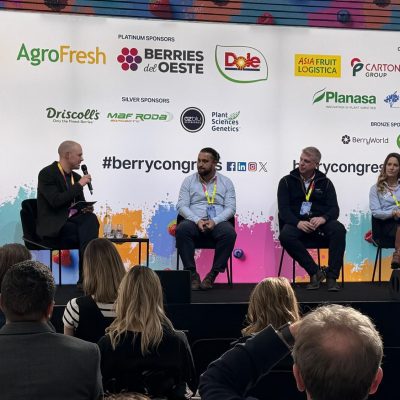
The event concluded with a roundtable discussion moderated by Pedro Brás de Oliveira. Among the participants was Nuno Silveira, one of the leading blueberry producers in Portugal.
The discussion addressed the need for greater collaboration among growers to elevate the reputation of Portuguese blueberries in export markets. Participants also recognized that while many farms operate at high technical levels, a portion of the sector still functions with a more amateur approach to production.
Reducing this gap and strengthening a culture of professional growers and technically managed farms was widely seen as essential for maintaining competitiveness.
Increasing Consumption: A Strategic Opportunity
Despite Portugal being a producing country, blueberries currently reach only around 18% of Portuguese households. Participants discussed strategies to increase national consumption and highlighted the potential role of Portugal Fresh in strengthening the visibility of Portuguese blueberries both domestically and internationally.
Final Reflection
Portugal has demonstrated its ability to build a competitive blueberry industry in a relatively short period of time.
The next challenge will be to transform that expansion into a fully professional sector capable of competing in a mature global market. The future of Portuguese blueberries may depend less on how quickly the sector continues to grow and more on how consistently it can deliver quality, professionalism and collective strategy.
03-19-2026
Source: Jorge Duarte – Hortitool Consulting