


Where are we? Where are we going?
- . March 2026
IBO’S annual general meeting in Berlin
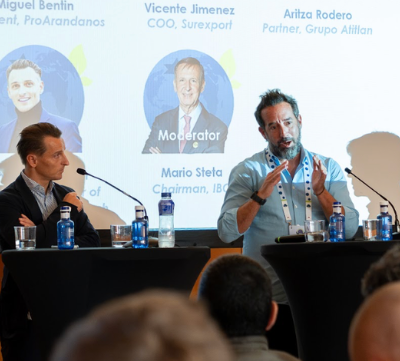
As has been the case for several years now, the IBO Annual General Meeting took place prior to Fruit Logistica in Berlin. With the participation of representatives from 18 countries, we had an opportunity to visualize trends, challenges and opportunities, and how the dynamics of the global blueberry sector are evolving.
Within the context of an open and direct dialogue by all participants, and supported by presentations made by the country representatives, we can conclude the following:
- Growth trends continue in almost all global regions, with some like Peru, Morocco and China with continued strong area and volume growth, and others like Mexico, Poland or Chile slowing or stopping as productivity, crop economics or genetic transitions are reviewed, corrective actions implemented and positive impacts take place. The overall health and profitability of the industry, as presented in our 2025 Global Industry Report and confirmed in Berlin, continues to be strong.
- The credibility of IBO as the global blueberry industry body continues to be recognized and valued as reflected by the incorporation of Ukraine, Romania, and Zimbabwe for a total of 18 countries, and over 80 members.
- There is clear recognition that while flavor and fruit quality are improving, genetic transitions need to be accelerated, as is happening in Peru and Chile, with the need to support and recognize efforts to enhance IP protection in some countries, with China being one example of focus and attention.
- Even though as we were meeting Iberia and northern Morocco were seeing their most intense rainfall accumulations in decades, and impacting by some estimates around 25% of the volume in Morocco between January and February (see related article), water scarcity remains a major global challenge, with labor availability also being a key concern in all production regions, with the possible exception of southern Africa.
- Trade and geopolitical impacts continue to be elevated as major concern; something unfortunately being further confirmed as I write this editorial.
As for planned IBO activities?
- Peru was confirmed as the host of our next Summit, with the event planned to take place in November of 2027.
- We will replicate the success of our Fruit Attraction gathering in Madrid in October.
- The first IBO member country visit and deep dive is being planned for the end of 2026.
- Initial steps for the implementation of our Strategic Plan process will be initiated.
- Work to understand the dynamics of new production in countries like India, Colombia, Turkey and Egypt.
- We will continue to enhance our presence at industry forums in the UK, Italy, Portugal, and particularly Georgia.
- Our support and interaction with in-country blueberry industry organizations will also be increased.
- And we will further focus on improving the quality of the IBO Newsletter and the services, like Blue Careers, associated to it.
- Peru was confirmed as the host of our next Summit, with the event planned to take place in November of 2027.
No doubt an ambitious agenda, which we will be able to deliver upon with the support of all IBO and industry members.
As is always the case when the opportunity to meet and interact with IBO members takes place, and beyond the formalities of the agenda and topics presented, the AGM meeting in Berlin generated two elements of attention and reflection.
The first one was actually exposed to me by a very smart and attentive member of Driscoll´s leadership team in EMEA. Very simply, why is there not more participation and presence of women at a meeting of this nature and overall leadership activities of IBO? More so in an industry that depends so much on the participation and quality of work of female farm workers? And even more so when the UN has named 2026 the International Year of the Women Farmer (IYWF)?
The second one is related to the presence of the Ukraine country representatives. Having the opportunity for direct dialogue and understanding of this deeply unfair and senseless situation, impacting now for four years the country and its people, the level of admiration and respect one further develops for what Ukrainians have gone and are going through is further elevated.
If farming and blueberry production are by its own nature complex and a high-risk activity, not only maintaining production but actually looking for growth and betting into the future in such an environment is in a way, something beyond comprehension. So, our deepest thanks to Natalya Pukshyn and her son Oleksandr, and to the whole blueberry industry in Ukraine, for their work and commitment, and for the perspective they provided on understanding what is truly and deeply important.
IBO Editorial
03-05-2026