

Latin America’s blueberry growers shift export focus as tariffs hit home
- . January 2026
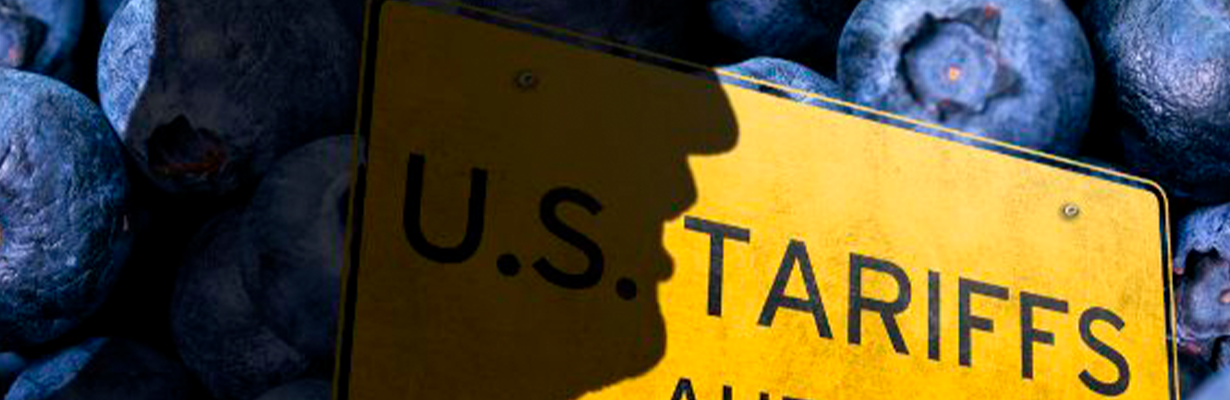
In the close to 12 months since their implementation, the tariffs introduced by the Trump Administration on April 2 2025 on countries including Peru and Chile has sparked a upheaval in the export regimes of nations that once counted on the U.S. for the majority of their non-domestic sales. But with Trump’s tariff facing an ongoing challenge in the U.S. Supreme Count, it is surely the right time to assess what impact the policy is having for blueberries in North – and South – America, and to look at where the situation might be headed.
As President of Peruvian blueberry association Proarándanos, Miguel Bentín is well placed to give a summary of how tariffs have affected Peruvian growers. The U.S., he says, is Peru’s principal export market for blueberries, historically receiving on average more than 50% of total volumes.
However, although Peru’s production for the 2025/26 season is on course to increase by 18%, volumes exported to the US have only grown by 5%. “I think the effect of the tariffs is more or less clear,” says Bentín. “From the point of view of exporters, the U.S. has lost attractiveness and competitively as a market,” he says.
In a similar vein, Andrés Armstrong, Executive Director of the Chilean Blueberry Committee, says the U.S. has been the main export market for Chilean blueberries ever since the country began to produce and export the fruit, although he adds that this situation has gradually changed as Chile has sought to diversity its overseas sales.
Although the U.S. accounted for some 43% of total Chilean fresh blueberry exports in 2025 – with Europe receiving a similar percentage – Armstrong says the impact of the Trump tariffs was most definitely felt during the year, even taking into account the steady growth of exports to Europe and Asia.
The U.S. perspective
Closer to home, Kasey Cronquist, President of both the U.S. Highbush Blueberry Council (USHBC) and the North American Blueberry Council (NABC), says the current trade environment is providing U.S. producers with opportunities to increase trade with export markets worldwide. “It has helped elevate conversations that have been stalled, and hopefully create opportunities in some countries and regions we have not been competitive in,” he says.
However, at the same time Cronquist says the trade environment has created a “level of uncertainty” about what those opportunities could look like, both for U.S. exporters in other countries, and overseas producers shipping to North America.
“We are still operating in the day-by-day situation of hopefully landing the plane on some of these agreements for access for U.S. blueberries in other countries, and certainly stability on blueberries coming into the U.S. to help provide year-round supply,” he says.
Europe ‘overtakes’ the U.S.
The tariff situation has also spurred Latin America’s blueberry exporters into shifting their focus to alternative markets. One such market is Europe where Peruvian blueberry exports grew by 35% in 2025, equivalent to seven times more than the previous year, according to Bentín.
However, although Europe remains a smaller market for Peruvian blueberries than the U.S., he believes tariffs have been the primary mover behind the volume increase. “If the volume shipped to Europe has grown 35% versus only 5% to the U.S., then it has definitely been influenced a lot by the tariff situation,” Bentín adds.
For Chile, the change in the export dynamic looks to be even more dramatic. Associating to Armstrong, Europe is currently on course to dislodge the U.S. as the largest export market for Chilean fresh blueberries. “If we look at the figures to date, where there has been a 10% increase in exported volume, Europe has grown by 25%, while the U.S. has fallen by 6%,” he says.
“This means Europe currently accounts for 53% of total exports and the U.S. is 35%. Although the end of the season isn’t far away, and we will probably see a slight increase to the U.S., it still won’t overtake the total volume exported to Europe, making Europe the biggest market for fresh Chilean blueberries for the first time.”
01-29-2026
IBO Exclusive Content.